

Stop saying sorry: it was no one's fault
Most bad nights on court aren't anyone's fault. They're a mismatch. Why racket sports need ability levels, and how Rallio Levels makes them work however your club already thinks about it.
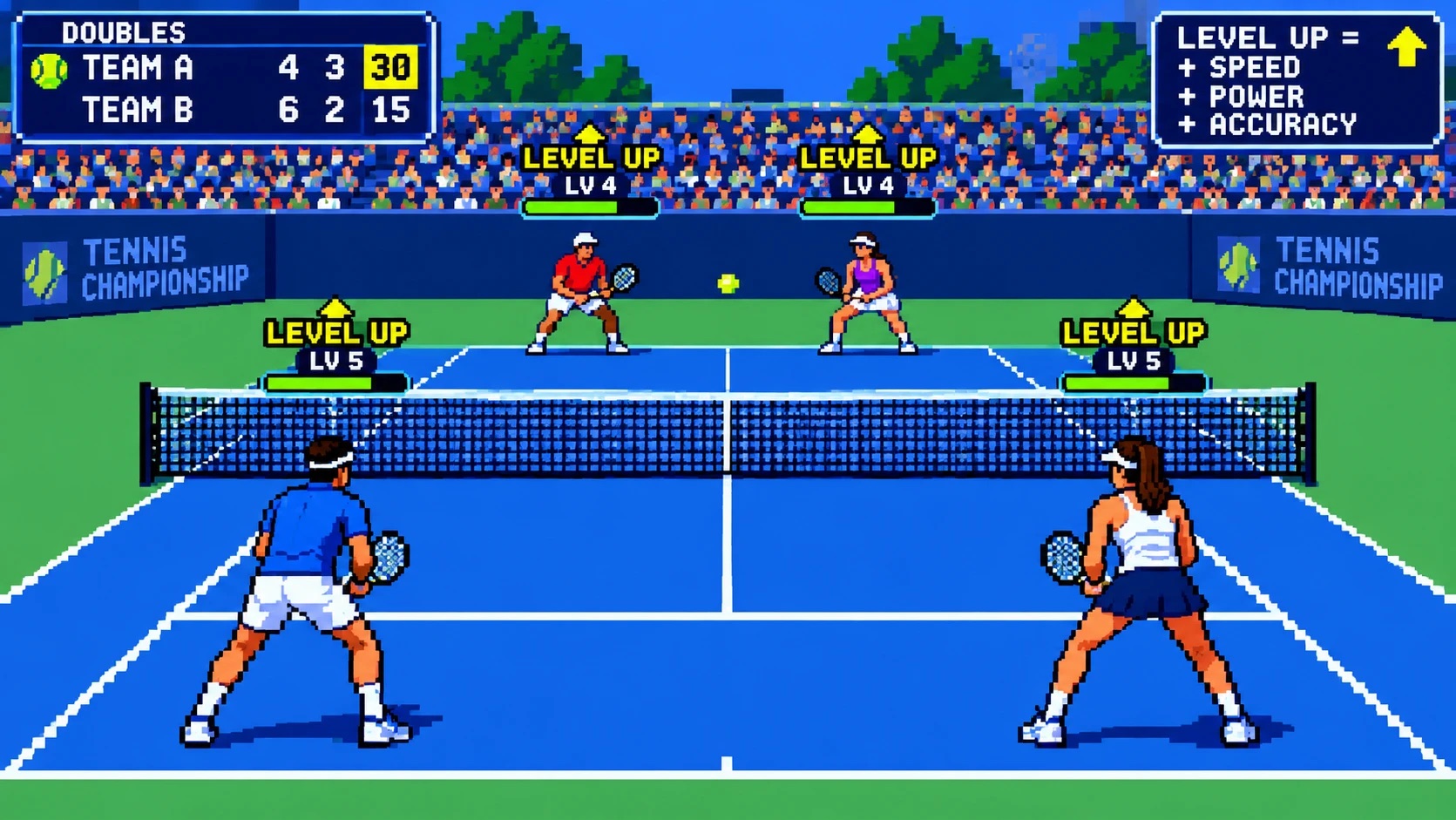
It's a Tuesday night mixer. It's your third week playing. You've finally started to get the hang of it, you're starting to hold a rally, and then the draw puts you on court two. Your partner is lovely. The two on the other side are not messing about.
The first serve goes past you before you've lifted the racket. The next one hits the back fence. By the fourth game you're hoping the ball goes anywhere other than towards you, which of course it does, with a volley thumped at you from three feet away.
Squash is no different: every shot hammered down the wall, past you. In padel you're pinned against the back glass while two players on the other side take turns sending the ball off every wall.
Then there's the other half of the ability curve. You ease off, serving at 50% and hoping for a return, but it clips the frame of your opponent's racket and disappears into the darkness of the night. Every rally is over in two shots, courtesy of an unforced error from the other side.
And then comes the soundtrack. "Sorry!" from the player who just fired it past you. "Sorry!" from you, for missing it. "Sorry, I'll ease off." "No, no, sorry, it's my fault." Half the conversation on court is two people apologising for a mismatch that neither of them chose.
We've all seen it. Maybe we've all been it. And nobody did anything wrong. The player who hit that smash wasn't being unkind; they were playing the way they always play. The problem wasn't the people. It was the match.
Nobody should have to say sorry on court. Not for hitting a winner, and not for being new. That's the reason racket sports need some kind of ability measure. Not for bragging rights, but so that nobody has the worst night of their sporting week at what was supposed to be a social.
The squeeze in the middle
Here's the thing about ability in any club: most people sit in the middle. Very few are at the very top, very few are at the very bottom, and the great bulk of players are somewhere around intermediate. Which sounds like it should make matching easy, until you remember that "intermediate" covers a lot of ground, and the people at the edges are the ones most likely to have a bad time.
So a good level system is really doing two jobs:
- Protecting beginners. Starting tennis or padel is a brilliant thing to do. But it only becomes a hobby if the first few sessions are fun. A beginner who gets paired with games they can compete in comes back next week. A beginner who gets peppered doesn't. Levels are how a club makes sure the people in that fragile first month feel confident enough to keep turning up.
- Keeping the strong players happy. Competitive and advanced players want a proper game too. Put them with the right people and they stay, and often they're glad to bring others along with them, to hit with, to encourage, to be part of a club that's growing.
Get both right and everybody wins: new players stay, strong players stay, and the middle gets better games too.
Fitting the levels to your club. Most rating scales are built for the whole world, which means the top of the scale is a county or professional player that most clubs will rarely see. Squeeze a whole club into the bottom half of a world scale and almost everyone lands in one or two big bands, which is exactly the middle where the mismatches happen. So Rallio lets a club fit its levels to the players it actually has: tell us roughly where your strongest members sit, and the bands stretch to fit. That gives the middle room to breathe, so "intermediate" becomes a few meaningful steps rather than one giant bucket.
So we measure ability
Every racket sport has found its own way of putting a number on you. Tennis has had NTRP in the US, ITN internationally, and more recently the World Tennis Number and UTR. Squash has its grades, club ladders and SquashLevels. Padel and pickleball are building their own versions. Walk into almost any club and someone will tell you they're "a 3.5" or "a B-grade" or "about a 4".
These systems exist for a good reason. A shared language for ability means a beginner doesn't get thrown against a county player, a club can build sensible groups, and competitions can be seeded fairly. They're also fascinating, because most started life as a practical fix for a very human problem: how do we stop mismatched games being miserable for everyone?
Where ranking really matters
In competition, ability wins. If you're in a knockout, a league or a ladder, the better player usually comes out on top, and that's how it should be. The scoreboard is the most honest judge there is.
But most of us aren't playing competition most of the time. We're playing on a Tuesday night social, a Sunday morning mixer, a casual evening with people from the club. Or we're looking for someone to hit with and keep the rally going. And in that world, the number matters for a different reason:
It isn't about who wins. It's about whether the game is fun, fair and competitive.
A great social game is close. Rallies go on. Everyone gets a chance to hit winners and everyone gets stretched. A mismatch, even between lovely people, is quietly dull for both sides. Knowing your ability is how you find a great match.
That's what we think about every day at Rallio.
Introducing Rallio Levels: your level, your way
Today we're launching Rallio Levels, built around one idea: your level should work however you and your club already think about it.
- Bring your own rating. Add the rating you already have, whether that's a World Tennis Number, UTR, DUPR, a Playtomic level or SquashLevels. Rallio doesn't make you pick a winner.
- Or use your club's own levels. Clubs can set up the bands they already use, with their own names and descriptions. "Improvers", "Intermediate A" or "Thursday Group 2" all work. Fully customisable.
- See yourself grow. Your level isn't a label stuck on you at sign-up. As you play, your Rallio rating moves with your results, and when it carries you past a band, your level moves with it. If your outside rating changes, just update it.
One level, working across the whole app
Your level isn't a badge that sits on your profile. It quietly does the work behind every way you play in Rallio, so a coach or organiser can see everyone's level, spot where adjustments are needed, and keep things fair without a spreadsheet.
Mixers: no more court-two nightmares. When an organiser builds the draw, they can see everyone's level at a glance and ask Rallio to balance the courts by ability, so no court is lopsided before a ball is hit. Stronger players get paired with those still finding their feet, and nobody ends up pinned against the back wall for the whole night. Same social, better games, and a lot less apologising.
Ladders: start in the right place. A ladder is all about ranking, and nobody enjoys starting at the bottom of one they've outgrown, or being dropped into a spot that's too high. When a new ladder is set up, levels give everyone a sensible starting rung, so the first few challenges are close ones. After that, your results move you, which is exactly how a ladder should work.
Comps: handicaps that level the field. Knockouts are where ability matters most, and also where the early rounds can be a foregone conclusion. Handicaps fix that, and levels are what make them practical. Organisers can have Rallio suggest starts based on the levels in the draw, with the stronger player starting on a minus score, and adjust any of them by hand. The score you record is always the score that was played; the handicap only sets the starting point. Everyone gets a proper game, and the better player still has to earn the win.
And every game you play builds your rating. Ladder challenges, box league matches and competition matches played without a handicap count in full; mixers and open games count for half, so one off night at a social won't knock you down a level.
No one system is "right". A club full of beginners and a club full of county veterans need different language. So we've made it adaptable rather than prescriptive.
The short version
Levels and ratings matter. But the real prize isn't the number, it's the great game the number helps you find, whether that's a Tuesday mixer, a ladder challenge or a knockout. It's the new player who comes back for week four, the strong player who's happy to bring them along, and a court where nobody has to say sorry.
Add your rating, use your club's levels, and start finding better matches.