

Finding a partner shouldn't be this hard
The 'I want a game on Saturday' problem is small for two people and impossible for forty. The answer isn't more apps — it's fewer decisions.
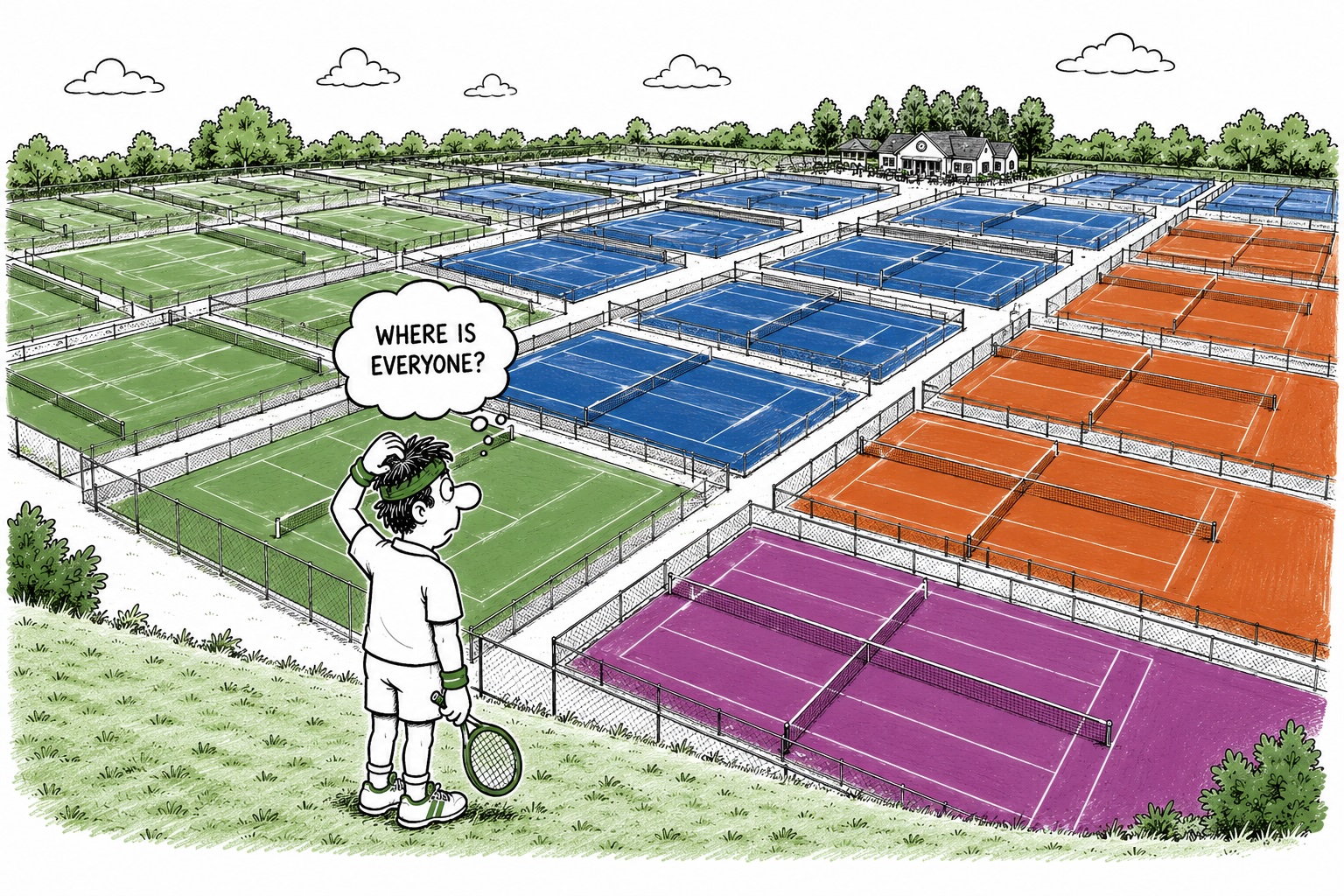
The hardest thing about being an intermediate club player isn't your forehand. It's finding somebody to play.
Not somebody, really — somebody at your level, free when you're free, willing to take it seriously enough to be fun. That last clause is doing most of the work. If the bar were just "two people with rackets", every Saturday would be sorted by Wednesday. It isn't, because the bar is "a good game", and a good game is a coordination problem with at least four moving parts: skill match, availability match, court access, and the simple human friction of asking.
The forgotten middle
Beginners get coaching groups. Team players get fixtures. Kids get squads. The intermediate social player — the people who make up the actual majority of any racket sports club — get a group chat.
They are too good to keep showing up to a beginners' social and lose nothing. They are not in a team. They don't have a coach scheduling things for them. They want a competitive-but-friendly game once or twice a week, and the work to find it is, week after week, on them.
Every existing tool in this space was built for somebody else. Court booking apps solve the court, not the people. Coaching platforms solve the coach, not the peers. Club management apps solve the organiser, not the player. The actual person whose Saturday is at stake has to assemble a working solution from three apps and a WhatsApp group.
More apps is the wrong answer
The reflexive solution is "an app for finding tennis partners". They exist; they have for a decade; they don't work. The reason is that an app for finding partners is the same coordination problem, with extra steps. You still have to swipe through strangers. You still have to negotiate skill levels with people you've never played. You still have to find a court. You still have to do this every single time.
What works is fewer decisions, not more.
Passive availability
The smallest move that fixes the most: say when you're free, and let the system handle the rest.
A ladder, run well, is exactly this. You join the ladder. You tell the system roughly when you can play. You don't message anyone. Other players within your range see your slots and challenge you. The system handles the chase. When the score comes in, the ranking updates. You did not ask anyone for a game; you made yourself available for one, and the structure delivered it.
This is a small philosophical shift with a large practical effect. You go from being the seeker — emotionally responsible for asking and being told no — to being the available, which is a much more comfortable place to live. The chase moves to the structure, which doesn't take rejection personally.
Where Rallio ladders fit
We built ladders in Rallio specifically for this. A continuous singles or doubles ranking. You join, you set when you're around, and the system surfaces challenges you can accept. Daily limits stop it becoming spam. Head-to-head badges remind you who you've already played. Disputes are first-class — if a score is wrong, the manager arbitrates without a forty-message argument.
You do not have to find a partner. You have to be findable. The rest is the structure's job.
If you've spent a decade saying "I just want a game on Saturday" and being mildly defeated by the process — try a ladder. Not ours specifically. Any ladder. The mental relief of stopping the chase is most of the prize.